Dubai Police Smash Their Own Guinness World Record at Global SWAT Challenge
Dubai, UAE — Dubai Police have once again etched their name in the record books, shattering their own Guinness World Record at the UAE SWAT Challenge 2026 by hosting the largest international tactical competition ever assembled. This year's edition drew elite special forces teams from 48 countries—two more than the previous record of 46 nations, set by Dubai Police themselves in 2025.
The achievement, certified at the seventh edition of the UAE SWAT Challenge held at Training City in Al Ruwayyah, underscores Dubai's emergence as a global epicentre for security cooperation, tactical excellence, and international law enforcement collaboration.
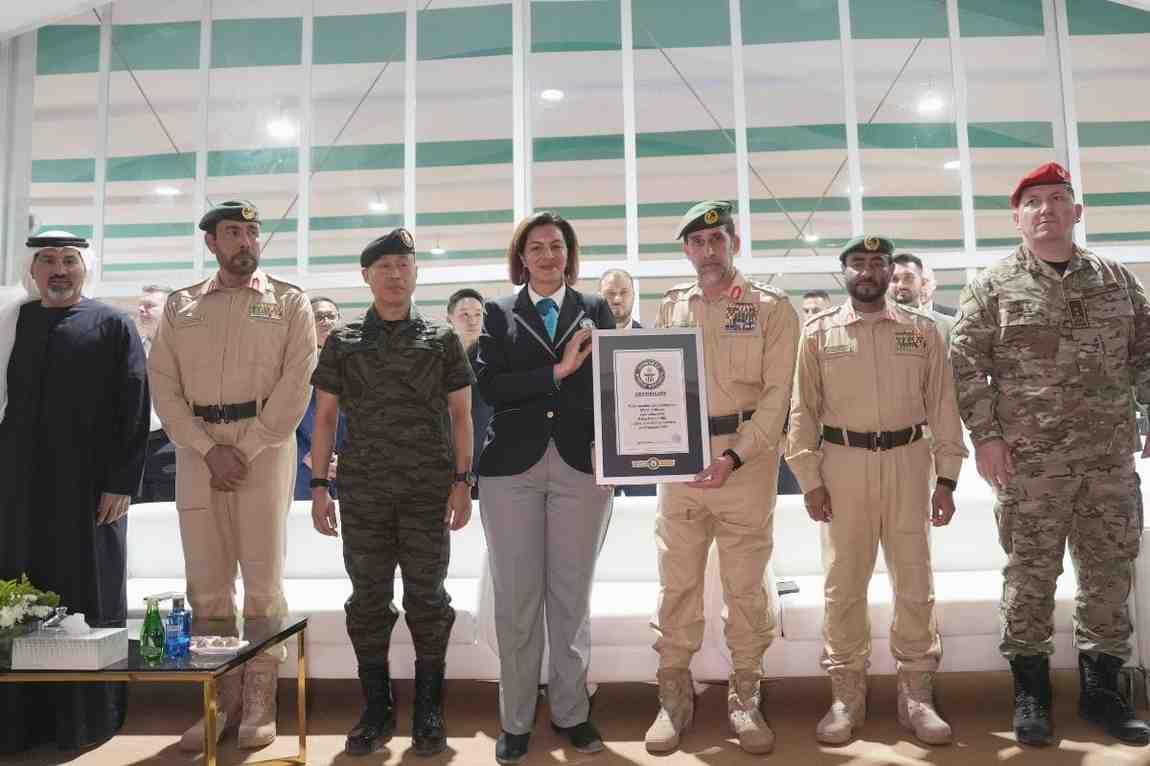
Lieutenant General Abdulla Khalifa Al Marri, Commander-in-Chief of Dubai Police, received the official Guinness World Records certificate from Senior Adjudicator Kanzy El Defrawy in a ceremony attended by senior officers and leaders of participating tactical teams from across the globe.
What the Record Means
The Guinness World Record recognizes the largest number of countries participating in a specialized SWAT tactical competition—a rigorous, high-stakes event designed to test elite units' operational capabilities under extreme pressure.
The expansion from 46 to 48 nations in a single year represents accelerating global recognition of the UAE SWAT Challenge's prestige and professional value. Teams now travel to Dubai from every continent, transforming what began as a regional competition into the definitive global gathering for counter-terrorism and special response units.
Organized by Dubai Police with support from the UAE Ministry of Interior, the challenge has evolved far beyond its competitive origins. It now functions as a strategic platform for:
- Tactical exchange — Sharing operational techniques and counter-terrorism methodologies
- Best practice dissemination — Adapting successful approaches across diverse national contexts
- Interoperability development — Building frameworks for multinational security cooperation
- Innovation acceleration — Exposing units to emerging technologies and tactical concepts
The Crucible: Five Days of Extreme Challenge
Over five intense days, competing teams navigate a battery of grueling scenarios designed to replicate the chaos, uncertainty, and lethal stakes of real-world counter-terrorism operations.
Assault Challenge:
Precision room-clearing, target discrimination, and coordinated movement under simulated fire. Teams must neutralize threats while distinguishing combatants from civilians—decisions measured in milliseconds.
Hostage Rescue Challenge:
The ultimate test of tactical discipline. Teams infiltrate complex environments, locate and secure hostages, eliminate hostage-takers, and extract survivors—all while managing incomplete intelligence and dynamic threats.
Officer Rescue Challenge:
Friendly down. Teams must reach, secure, and evacuate a wounded officer while engaging hostile forces—a scenario that tests both tactical proficiency and the unwillingness to leave anyone behind.
Tower Challenge:
Vertical assault operations requiring rope work, rapid ascent, and coordinated entry at height. Physical endurance meets technical precision.
Obstacle Challenge:
Pure athletic brutality. Walls, tunnels, cargo nets, and confidence courses demand maximum exertion after days of accumulated fatigue.
Each discipline reflects evolving operational realities faced by law enforcement and military special units worldwide. The scenarios are not abstract—they are drawn from hostage crises, terrorist sieges, and high-risk warrant operations that have occurred in the participating nations themselves.
Global Participation: Every Continent, Elite Standards
The 2026 UAE SWAT Challenge assembled an unprecedented coalition of tactical excellence.
- Asia: Host nation UAE fielded multiple teams, joined by Saudi Arabia, Qatar, Jordan, Kazakhstan, China, India, and Singapore.
- Africa: Morocco, Egypt, Rwanda, South Africa, and Nigeria demonstrated the continent's growing counter-terrorism capabilities.
- Europe: France's RAID and GIGN, Germany's GSG9, Italy's NOCS, and units from the UK, Spain, and Eastern Europe brought decades of operational experience.
- Americas: The United States, Canada, Brazil, and Colombia deployed elite teams with diverse tactical traditions.
- Oceania: Australia and New Zealand completed the truly global field.
This geographic diversity transforms the challenge from a competition into a living database of global tactical practice. A technique developed for favela operations in Rio may prove adaptable to urban counter-terror in Mumbai. A breaching method pioneered in Paris may find application in Nairobi.
Beyond the Record: Dubai Police's Legacy of Excellence
This Guinness World Record is not an isolated achievement. It represents the latest chapter in Dubai Police's sustained commitment to operational excellence, technological innovation, and international partnership.
- The force has previously secured world records for:
- The fastest police-developed drone, demonstrating commitment to aviation technology integration
- Largest human awareness ribbon for community safety campaigns
- Multiple records in driver training and precision maneuvering
More significantly, Dubai Police have established themselves as architects of global security architecture—not merely participants, but conveners and standard-setters.
Strategic Impact: Why 48 Nations Matters
The expansion to 48 participating countries carries implications far beyond record books.
Diplomatic value:
The UAE SWAT Challenge brings together nations that may lack formal security cooperation agreements. In Dubai, officers from rival states train on adjacent ranges, build professional relationships, and develop channels for future collaboration.
Capacity building:
Smaller nations with developing tactical capabilities benchmark themselves against established global leaders. The exposure to advanced techniques and equipment accelerates their professional development trajectories.
Counter-terrorism harmonization:
As terrorist networks operate across borders, counter-measures must similarly transcend national boundaries. Shared training standards and interoperable tactics developed at events like the UAE SWAT Challenge enable more effective multinational response.
Dubai's positioning:
Each participating team returns home as an ambassador for Dubai's security infrastructure, training facilities, and hospitality. The event functions as a soft power multiplier, demonstrating UAE leadership in a domain critical to every nation.
The Ceremony: Recognition and Resolution
At the record certification ceremony, Lieutenant General Abdulla Khalifa Al Marri emphasized that the achievement reflects collective commitment rather than institutional vanity.
"This Guinness World Record is not just about numbers. It represents professionalism, readiness, and mutual respect among law enforcement agencies worldwide. The true victory is the knowledge exchanged, the partnerships formed, and the shared commitment to protecting our communities."
Kanzy El Defrawy, the Guinness World Records Senior Adjudicator, noted the difficulty of surpassing one's own benchmark: "To break a record is exceptional. To break your own record, in consecutive years, with increasingly demanding criteria—that demonstrates genuine, sustained excellence."
Looking Ahead: The 2027 Challenge
With 48 nations now the standard, organizers face the challenge of continued expansion. Discussions are already underway regarding 2027 participation, with expressions of interest from additional nations in Latin America, Southeast Asia, and Africa.
Infrastructure constraints may eventually limit growth—Training City's facilities, though world-class, have maximum capacity. Yet Dubai Police have consistently demonstrated ability to scale operations while maintaining quality.
The target is no longer merely numerical. It is substantive: deeper integration, more sophisticated scenarios, greater technology infusion, and ultimately, more effective counter-terrorism capability distributed across the globe.
Also Read: Abu Dhabi to Dubai in Just 25 Minutes? UAE's Electric 'Flying Boats' Could Revolutionize Water Travel
Conclusion: More Than a Record
The UAE SWAT Challenge 2026 produced a champion—Team Kazakhstan "C", whose gold medal performance earned global recognition. It produced a runner-up—Team Kazakhstan "A", whose silver finish demonstrated the depth of Central Asian tactical development.
And it produced a record: 48 nations, one competition, one city.
But the lasting achievement of Dubai Police's Guinness World Record is not the certificate displayed at headquarters or the entry in the famous book. It is the hundreds of tactical operators who arrived in Dubai as strangers and departed as professional colleagues. It is the techniques learned, the contacts exchanged, the trust built.
Forty-eight nations competed. Forty-eight nations learned. And Dubai Police, once again, demonstrated why they are not merely hosts of global security dialogue—they are its architects and accelerators.