
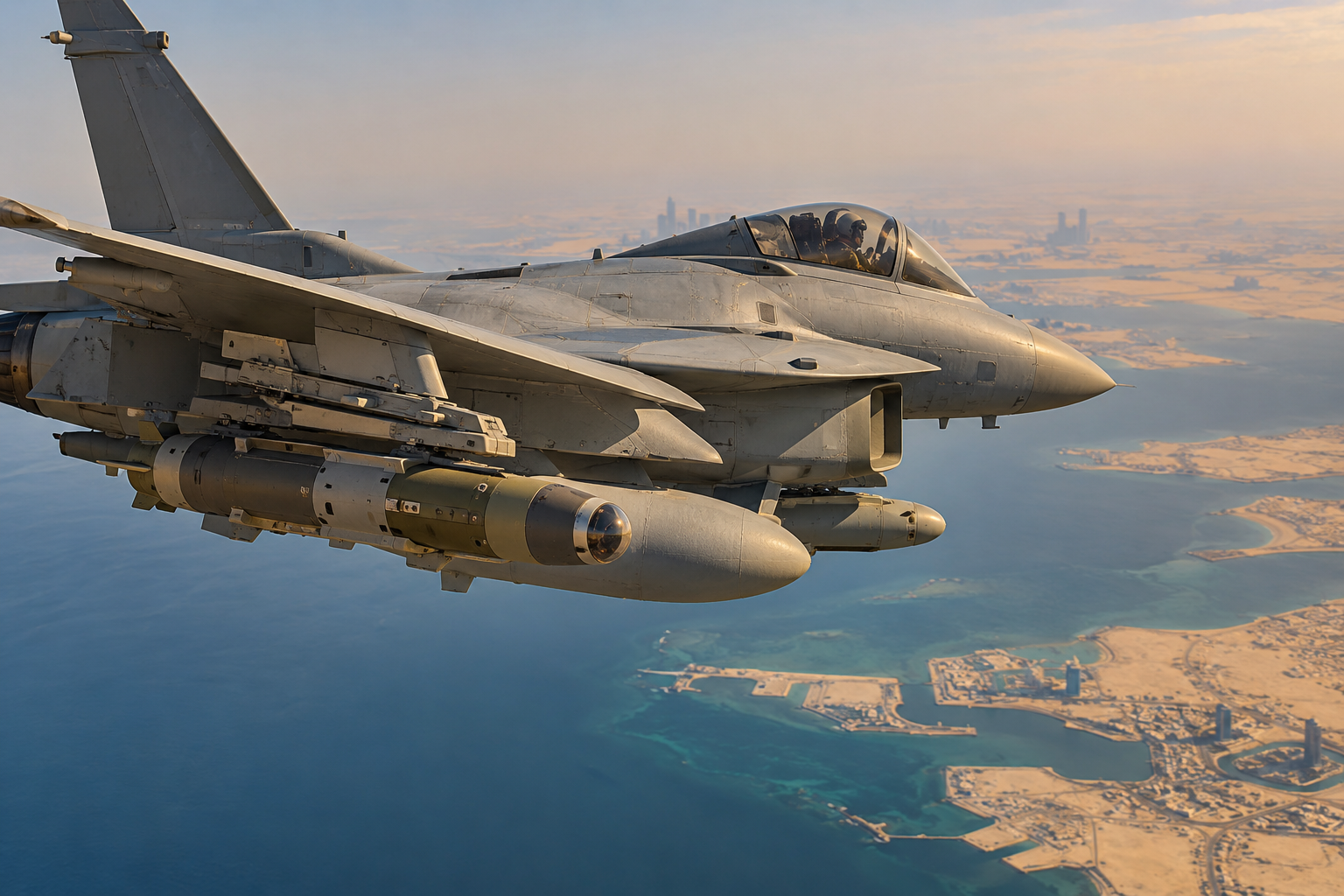
US Approves $1 Billion Sale of Rocket Guidance Kits to the UAE
The US State Department has approved the proposed sale of up to 10,000 Advanced Precision Kill Weapon System guidance sections to the UAE, valued at $1 billion. The system turns unguided rockets into precision munitions, including against drones. The announcement came as Gulf states continue to face Iranian drone and missile threats.
Washington has cleared a $1 billion weapons sale to the United Arab Emirates, a deal built around a comparatively cheap technology that has become increasingly relevant to Gulf air defence: guidance kits that turn ordinary rockets into precision munitions.
What the US has approved
The State Department announced on Monday that it had approved the proposed sale of up to 10,000 Advanced Precision Kill Weapon System, or APKWS, guidance sections for rockets. In its statement, the department said the sale would strengthen the UAE's ability to meet present and future threats by maintaining a ready self-defence capability, and would improve interoperability with US forces. It added that the deal serves American foreign policy and national security goals by supporting the security of a major defence partner.
As with other proposed foreign military sales, the approval marks a stage in a process rather than the delivery of equipment. The announcement does not set a delivery schedule, and such sales usually involve notification to Congress and further contracting steps.
Why this system matters
APKWS is a guidance kit fitted to existing unguided rockets. Once fitted, a rocket that previously flew on a fixed trajectory can be steered toward a specific target. The practical appeal is cost. The system can be used against a range of targets, including drones, which means a defending force can answer a low-cost aerial threat without firing an expensive interceptor missile.
That cost logic has taken on new weight in the region. Military planners across the Gulf have watched adversaries use inexpensive drones in large numbers, forcing defenders to spend far more to stop them than the attackers spent to launch them. Guided rockets fired from aircraft or ground platforms offer one way of narrowing that gap.
The regional backdrop
The announcement lands in the middle of a prolonged regional conflict. The war involving Iran began in late February with joint US and Israeli strikes and is now in its eighth month. The UAE and other US-allied Gulf states, several of which host American bases, have been hit repeatedly by Iranian drones and missiles during that time.
Attention in recent days has also focused on Yemen and Saudi Arabia, where the Iran-backed Houthis have claimed strikes on Saudi airports and an Aramco refinery, and where Saudi officials have confirmed attacks on two airports, reporting three minor injuries. A new defence pact involving Saudi Arabia, Turkey and Pakistan has meanwhile moved toward the deployment of forces to the kingdom. Together, these developments underline why air and drone defence is high on every Gulf capital's agenda.
A wider package for the Gulf
The UAE was not the only Gulf state to receive approval on Monday. The State Department also cleared a $400 million sale to Kuwait covering repair and return services for Patriot missiles, which have played a key part in countering Iranian attacks. Kuwait said it would use the added capability to strengthen its homeland defence, according to the department.
Taken together, the two announcements point to Washington's continued emphasis on maintaining and replenishing Gulf defences while the conflict remains unresolved.
What it means for the UAE
For the UAE, the deal follows a pattern of steady defence procurement from the United States over the past several years, including earlier approvals of precision munitions and other equipment. The latest sale is notable less for its headline value than for the type of capability it adds: a scalable, lower-cost option for dealing with drones at a time when the threat is persistent.
The UAE has not, in the information published so far, detailed how or where it would deploy the guidance sections. Nor has the timeline for contract signature and delivery been made public.
What to watch next
Observers will be looking for three things: whether Congress raises any objections during its review, how quickly contracts are finalised, and whether further defence approvals follow for other Gulf partners. The broader diplomatic picture also matters. Talks between Washington and Tehran remain at an impasse, and Iran's president has dismissed negotiations as meaningless, so the security environment that prompted the sale shows few signs of easing.
For now, the approval is a clear signal of how closely the UAE's security planning remains tied to its relationship with the United States, and how central drone defence has become to that partnership.

Leave a comment
Your email address will not be published. Required fields are marked *