
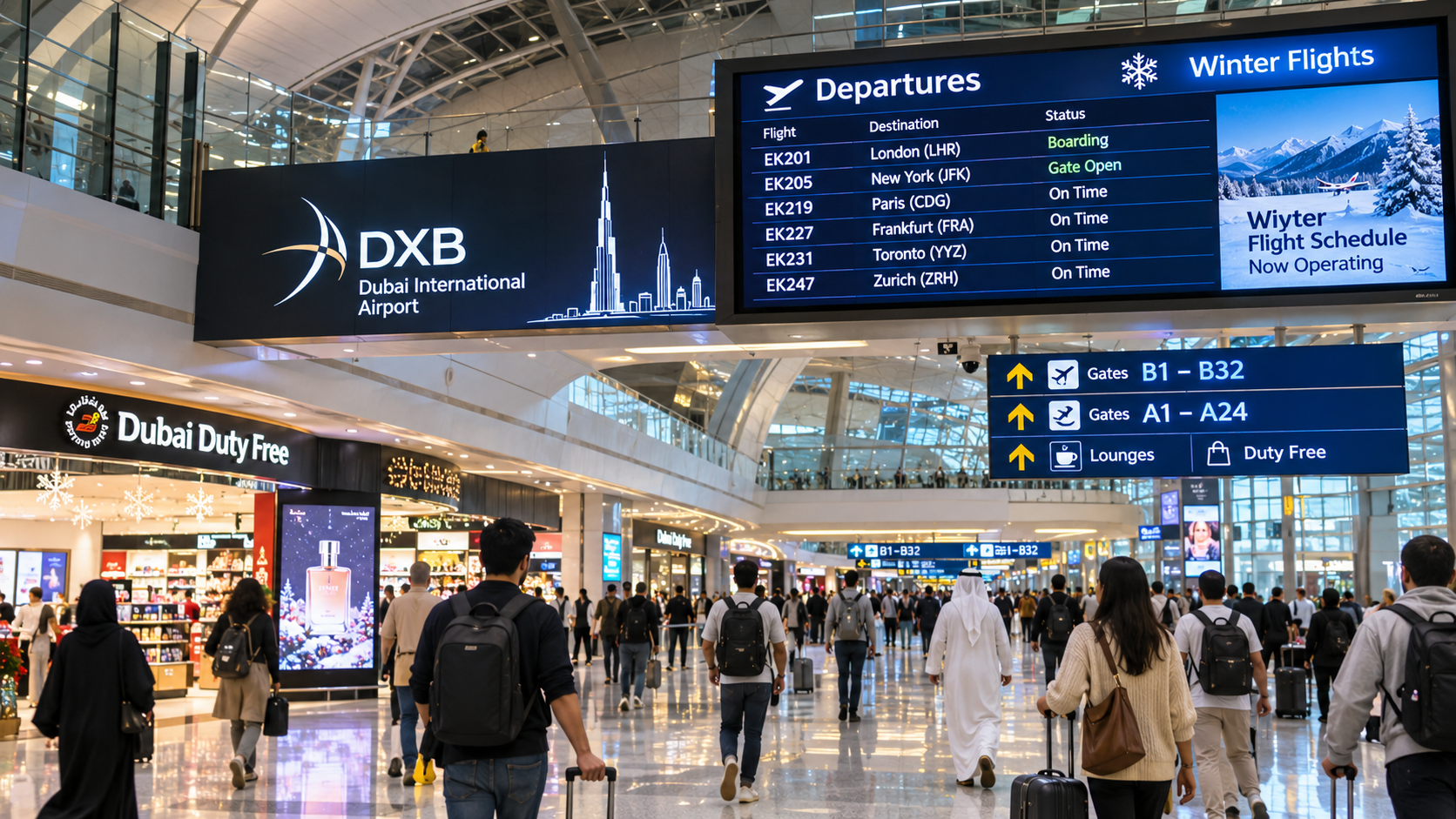
Dubai Airport Handles 50.4 Million Passengers in Nine Months as Recovery Gathers Pace
Dubai International Airport welcomed 50.4 million passengers between January and September, 28.1 per cent fewer than a year earlier, but the third quarter showed a clear improvement. Dubai Airports expects more than 70 million travellers for the full year, against a record 95.2 million in 2025.
Dubai International Airport (DXB) welcomed 50.4 million passengers in the first nine months of 2026, its operator, Dubai Airports, said on Tuesday. The figure is a reminder of how far the world's busiest international hub has slipped from its record-setting 2025, and of how steadily it has been climbing back since the regional conflict hit air travel hardest.
Between January and September, passenger numbers were 28.1 per cent lower than in the same period last year. Yet the direction of travel inside that figure is more encouraging than the headline decline suggests.
A recovery that is building quarter by quarter
The second quarter was the low point of the year, with 13 million passengers passing through DXB. That took first-half traffic to 31.5 million, a fall of 31.3 per cent from the first six months of 2025.
The third quarter was markedly better. The airport handled 18.8 million passengers, down 22.1 per cent year on year, and August was the busiest single month at 6.6 million. Put simply, the gap with last year has narrowed by about nine percentage points between the first half and the third quarter. It remains a deep gap, but it is closing.
What the operating figures reveal
The wider performance data suggest a hub that is running fewer flights rather than emptier ones. Aircraft movements fell 27.6 per cent to 243,000 over the nine months, close to the decline in passengers. The average load factor was 74 per cent, three percentage points below a year ago, while the average number of passengers per movement was 211, only 0.8 per cent lower.
Cargo was softer too. Volumes slipped 23.2 per cent to 1.215 million tonnes. On the ground, the baggage system processed 48 million bags, with 91 per cent delivered within 45 minutes of arrival, according to the operator.
Who is flying
India remained the largest country market in the third quarter, with 2.6 million passengers. Saudi Arabia followed on 1.4 million and the United Kingdom on 1.3 million. Pakistan accounted for 800,000 passengers, the United States for 640,000 and Germany for 480,000.
The mix of traffic matters as much as the total. In September, passengers travelling directly to or from Dubai made up 49 per cent of the traffic, while connecting passengers made up 51 per cent. Transfer traffic sits at the heart of DXB's business model, which is why the pace at which airlines rebuild their networks has such a direct bearing on the airport's fortunes.
Airlines are returning, but not all at once
That rebuilding is uneven. Aviation industry publication Skift reports that DXB is now served by 57 airlines, compared with 108 last year, meaning nearly half have yet to return.
Some are coming back. British Airways is operating daily flights from London Heathrow, while Lufthansa and Eurowings are due to restart Munich and Berlin services on November 25. Others are staying away longer. According to airline notices compiled by Gulf News, Lufthansa Group's Frankfurt and SWISS Zurich flights will stay suspended through the winter schedule that ends on March 27, 2027. Singapore Airlines has pushed its return to the end of February 2027, and Cathay Pacific to the end of January.
The outlook for the rest of 2026
Paul Griffiths, chief executive of Dubai Airports, said the airport expects to welcome more than 70 million passengers this year. Reaching that mark would require roughly 19.6 million travellers in the final quarter, a little above the third quarter's 18.8 million. It would still leave the year about a quarter below 2025's total of 95.2 million, the highest annual international passenger figure ever recorded by any airport.
The airport has also pushed back its ambition of reaching 100 million passengers by a year, to 2027.
Winter should help. The balance usually tilts towards direct traffic in the cooler months, when Dubai's tourism calendar and major events draw international visitors. Work also continues on the expansion of Al Maktoum International Airport (DWC), where a $35 billion programme was announced in May 2024.
What it means for travellers and the wider economy
For passengers, the returning European services from late November should add seats at a time when winter demand is building. For Dubai's tourism, hospitality and retail sectors, which depend heavily on the flow of visitors through DXB, every additional route restored is a boost.
The caution is that the recovery remains tied to the security picture. The European Union Aviation Safety Agency has extended its warning for Gulf airspace until January 31, 2027, and several carriers continue to revise their schedules. Travellers are advised to confirm their flight status with their airline before heading to the airport.
For now, the nine-month numbers describe a hub that has stabilised and is rebuilding, though it is not yet restored to its former scale.

Leave a comment
Your email address will not be published. Required fields are marked *