
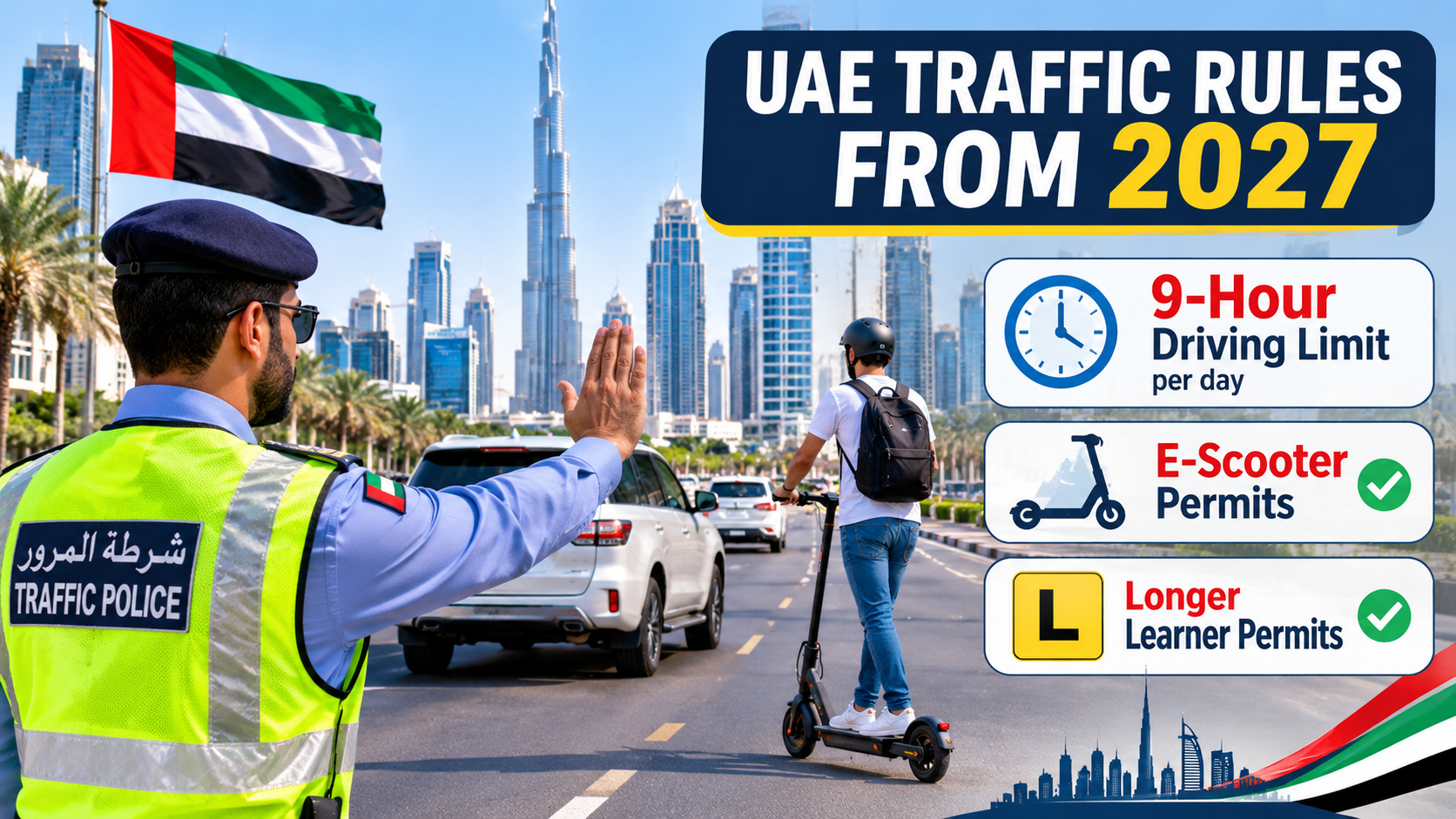
New UAE Traffic Rules for 2027: Nine-Hour Driving Limit, E-Scooter Permits and Longer Learner Permits
Federal traffic regulations taking effect on 1 January 2027 cap driving at nine hours in any 24-hour period and introduce e-scooter permits, longer learner permits and new rules for delivery riders. Several practical details, including enforcement, are still unclear.
Millions of UAE motorists will be driving under a new federal rulebook from 1 January 2027, and one change in particular has drawn attention: a ceiling of nine hours of driving in any 24-hour period.
The rules are set out in Cabinet Decision No. 174 of 2026, the executive regulation of Federal Decree-Law No. 14 of 2024 on traffic. It replaces Ministerial Decision No. 130 of 1997 and its implementing decisions, and Article 131 fixes the start date as 1 January 2027, according to a Khaleej Times explainer published on Tuesday.
The nine-hour driving limit
Article 7(2) states that driving time must not exceed nine hours within 24 hours. The wording is general: it does not single out truck drivers, taxi drivers or other professionals, so it applies to all motorists. The Federal Traffic Council has the power to change the limit.
The same article separately bars anyone from driving while fatigue or exhaustion affects their ability to do so safely, even if they have not reached nine hours. That ban already existed; the numerical cap is the new element.
Practical questions remain. According to Gulf News, the regulations do not say how driving hours will be monitored, whether rest breaks are mandatory or whether a separate penalty applies for exceeding the limit. Khaleej Times adds that the clause does not describe nine consecutive hours or say how time will be recorded.
Pressure on drivers who work shifts
The rule could matter most for people who drive for a living. The National reported that 12-hour shifts are currently common among taxi drivers and that many transport companies run vehicles on similar schedules. One analyst quoted by the newspaper welcomed the safety benefits but warned that the limit could reduce revenue for drivers and affect business plans, and argued that employers, not only drivers, should be responsible for compliance.
For comparison, The National noted that daily driving limits for heavy vehicles in the United Kingdom and the European Union are typically nine or ten hours, though drivers may stay on duty for longer for tasks such as loading.
E-scooter and e-bike permits
Under Article 59, riders of electric scooters, electric bicycles and small motorised bikes will need a permit, valid for three years. Applicants must be at least 15 years old. Khaleej Times points out that this is an application age rather than a stated riding age for every category, and that the federal text does not explain how it fits with Dubai's existing scheme, which requires applicants to be 16 and issues permits without an expiry date.
Riders must stick to designated routes and speed limits and stay off roads reserved for vehicle traffic. Required equipment includes a headlight, a rear light, a red brake-linked light, a handlebar-mounted audible warning device and a working rear brake. No nationwide numerical speed limit is set for e-scooters.
Licences, learners and the road
Several other changes affect everyday drivers:
Old licences: Anyone renewing a licence that expired more than ten years ago must pass theory and practical tests set by the licensing authority (Article 76).
Learner permits: These can be valid for up to six months, up from three under the previous federal regulation (Article 82).
Child seats: Children aged four and under must use a suitable rear child seat. A child over ten, or who has reached 145 cm, may sit in the front.
Delivery riders: Backpacks are banned for carrying orders, and passengers are barred from riding behind delivery riders on motorcycles licensed for that purpose. Professional drivers must hold valid permits.
Overtaking and crossings: Existing restrictions largely continue, and drivers must slow down and be ready to stop at marked pedestrian crossings.
Vehicle ownership limit on hold
A separate provision on the number of vehicles a resident can license, in Article 89, has been put on hold. The Ministry of Interior said it would postpone implementation pending a review that takes account of vehicle owners' rights, family and investor needs, and how vehicles are used, including classic and luxury cars. Gulf News had earlier reported that the limit was five vehicles for individual residents.
Safety groups welcome the direction
RoadSafetyUAE, a road safety organisation, applauded the new set of rules but called for clearer guidance on designated riding areas and further measures to protect delivery riders, Khaleej Times reported.
What drivers should do now
With around seven weeks before the rules take effect, motorists, employers and delivery companies have time to prepare. Fleet operators in particular may need to review rosters. Drivers should watch for guidance from the Ministry of Interior and local authorities such as the RTA and the police on how the nine-hour limit will be applied in practice, and anyone with a long-expired licence should check renewal requirements ahead of time.

Leave a comment
Your email address will not be published. Required fields are marked *