
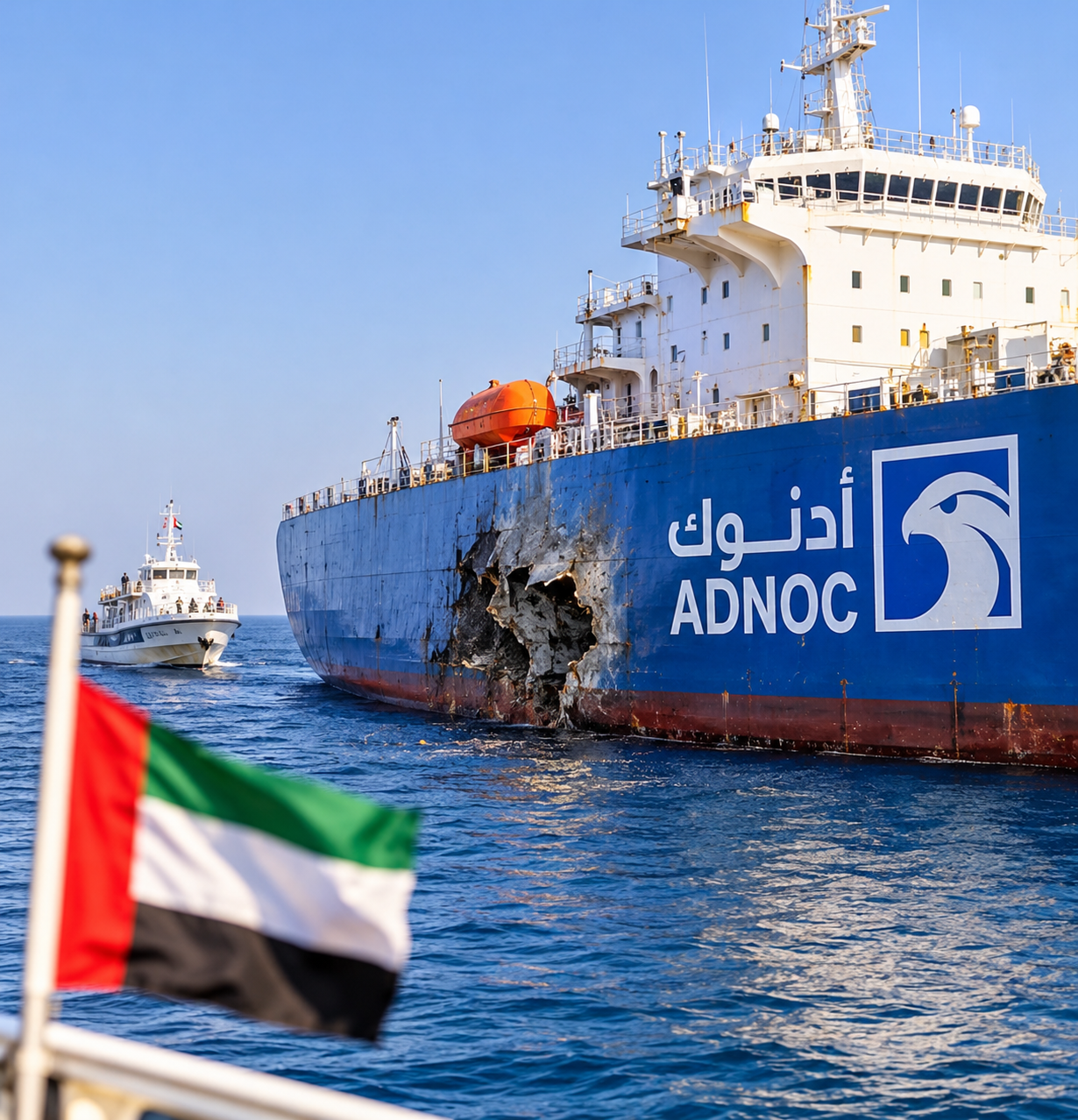
ADNOC Vessel Damaged in Attack Inside UAE Territorial Waters
An ADNOC Logistics & Services vessel was damaged in an attack in UAE territorial waters in the Arabian Gulf on Tuesday afternoon. The company says response teams are working and more details will follow. It is the latest in a run of strikes on Gulf shipping since the regional war began in February.
An commercial vessel operated by one of Abu Dhabi's biggest energy groups was damaged on Tuesday afternoon in an attack inside the UAE's own territorial waters in the Arabian Gulf, adding to a string of incidents that have unsettled shipping across the region.
ADNOC Logistics & Services confirmed that one of its vessels sustained damage and said response teams were already working on the situation. The company promised further updates as more information becomes available. In the statement carried by the Emirates News Agency, WAM, members of the public were asked to rely only on official sources and to avoid passing on rumours or unverified claims.
What is known so far
Very little detail has been released. The statement did not name the vessel, describe its cargo, say whether anyone on board was hurt, or identify who carried out the attack or how it was carried out. Khaleej Times published the first report of the incident at 6:53 pm local time on Tuesday, and the situation was still developing in the early evening.
Those gaps matter. In earlier incidents involving the company, the casualty position was the first thing authorities clarified. Until ADNOC or the relevant UAE authorities say more, it would be premature to draw conclusions about the severity of the damage or the nature of the weapon involved.
Not the first strike on an ADNOC vessel
ADNOC Logistics & Services runs a fleet that serves the global energy industry, and its ships have been in the firing line before. According to The National, two crude oil tankers operated by the company were struck by projectiles in the Strait of Hormuz in July, killing one crew member and injuring others. Another company ship was attacked in August, although no injuries were reported.
In an August statement, ADNOC said more than a dozen of its vessels had been targeted by missiles and drones while passing through the strait since the United States and Israel launched the war on Iran in February. It reported at the time that one crew member had died and 20 others had been wounded. On that occasion the UAE Foreign Ministry publicly blamed Iran for the attack.
Tuesday's incident is different in one respect: it happened in the country's territorial waters rather than in the contested approaches to the strait itself.
A wider pattern in the Gulf
The attack comes barely ten days after Qatar Gas Transport Company, known as Nakilat, reported that its vessel Al Maayeda had been struck by unidentified objects while sailing in the Arabian Gulf on 30 October. Nakilat said no crew were injured, there was no environmental impact and the ship remained safe and operational.
The UAE Ministry of Foreign Affairs condemned that attack, calling it a grave threat to the safety of maritime navigation and global energy supplies and warning of serious environmental consequences. The ministry described the incident as a dangerous escalation aimed at undermining the security and stability of critical waterways.
Commercial traffic through the Strait of Hormuz remains well below normal. The latest weekly figures from the UK Maritime Trade Operations centre, cited by Gulf News, show 170 outbound and 155 inbound transits, roughly 65 per cent below levels before the conflict. UKMTO also classed a tanker fire off Khasab, in Oman's Musandam peninsula, as an attack on Tuesday.
The regional picture on the same day
Tuesday was crowded with security developments. The Saudi-led coalition said its air defences intercepted a ballistic missile and a cruise missile fired by Houthi forces towards Riyadh, while a drone was destroyed over Saudi Arabia's Eastern Province. Gulf Cooperation Council states approved the creation of a joint military command headquarters in Kuwait, the bloc's secretary-general said.
On the diplomatic side, US President Donald Trump said after talks with Qatar's prime minister that fresh military action against Iran did not look necessary for now, although he stressed that Washington remained ready to act. The US naval blockade of Iran continues, and diplomatic efforts have not yet produced a breakthrough.
Why it matters for the UAE
For a country whose economy leans heavily on energy exports, shipping safety is not an abstract concern. ADNOC's vessels carry crude and other cargoes to customers around the world, and each strike raises the cost and risk of moving them. Gulf producers have leaned on routes that avoid the Strait of Hormuz, including Fujairah on the UAE's east coast, but the Arabian Gulf remains central to the region's trade.
An attack in UAE territorial waters also raises the stakes politically. The government has so far responded to incidents with public condemnation and calls for freedom of navigation, and it has coordinated with its Gulf partners on defence. Whether Tuesday's attack changes that approach will depend on who is held responsible and how much damage was done.
What to watch next
Three things will shape how this story develops. The first is whether ADNOC confirms that all crew members are safe. The second is any formal attribution from the UAE Foreign Ministry. The third is whether the attack affects loading schedules or tanker movements out of Abu Dhabi in the days ahead.

Leave a comment
Your email address will not be published. Required fields are marked *