
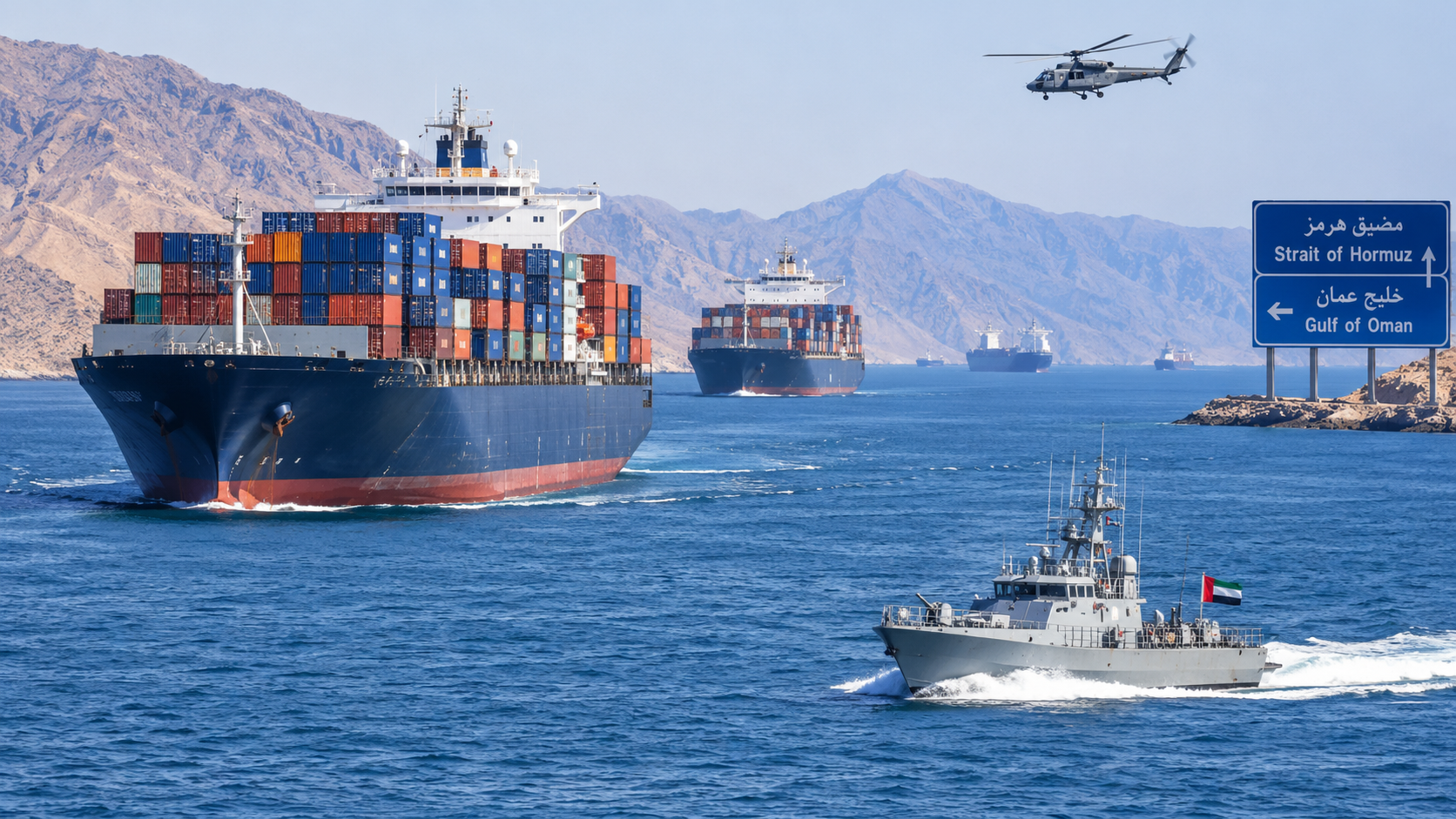
US Widens Iran Blockade as Hormuz Tensions Climb: What UAE Residents Should Know
Washington has launched a new task force to choke Iran's land and Caspian Sea supply routes, while Tehran has lifted limits on its missile range and says Hormuz stays closed until its demands are met. Diplomacy continues, but flights, shipping and regional security remain exposed.
The confrontation between Washington and Tehran entered a sharper phase this weekend, with the United States widening its blockade of Iran and Iran warning that any new attack would be met with a response that has no geographic limit. For people living in the UAE, the effects are concrete: disrupted flights, anxious shipping lanes and a steady drumbeat of security alerts across the Gulf.
A new task force targets Iran's land routes
US Central Command has set up a body called Task Force Iron Gate, designed to disrupt Iran's use of land borders and the Caspian Sea to move advanced weapons, dual-use technology and sanctioned materials. The unit is small, with about 20 civilian and military personnel, and will work alongside other US government agencies.
CENTCOM commander Admiral Brad Cooper said the effort is meant to curb Iran's ability to fund militant groups, rebuild weapons factories and replenish its forces. The command also claimed that the naval blockade of Iranian ports has already stopped Iran from exporting more than $25 billion worth of crude oil in recent months.
Iran's Revolutionary Guards dismissed the expansion as little more than a change of wording. Their spokesman argued that Washington cannot collapse Iran's economy this way and pointed out that an earlier American forecast of economic collapse within two weeks had not come true.
A merchant ship disabled in the Gulf of Oman
The blockade also turned physical on Saturday. CENTCOM said it disabled the St Kitts-flagged cargo ship M/V Huda in the Gulf of Oman after its crew ignored repeated warnings and tried to leave regional waters following a visit to an Iranian port. The command released video showing a US aircraft firing precision munitions at the ship's stern. It said the crew had been told to move away from the targeted areas first.
In a separate and unrelated rescue, the UAE National Guard brought 22 sailors to safety after a fire aboard another cargo ship in the same waters. Officials have not connected the two events.
Tehran's response and the missile question
Iran's military has used the same period to project strength. The Revolutionary Guards lifted restrictions on the range of their ballistic missiles, and an army spokesman said the armed forces are on higher alert and stronger than at the start of the conflict, now in its eighth month. Iran has repeated that the Strait of Hormuz will stay closed until Washington meets its demands.
Iranian media also reported explosions on Qeshm Island and in the southern cities of Jask, Sirik and Bandar Abbas. The cause of those blasts was not immediately clear, and early reports said there was no damage on Qeshm. The Revolutionary Guards separately said two oil tankers caught fire after striking naval mines on what they called an unauthorised route. That claim has not been independently verified.
Iran's Supreme Leader, Ayatollah Mojtaba Hosseini Khamenei, added a political note, saying the outcome of the American midterm elections would not change Tehran's defensive strategy and warning against concessions to Washington.
Spillover across the Gulf
The Saudi-led coalition fighting Yemen's Houthis said it intercepted ballistic missiles fired at the kingdom, including two aimed at Riyadh and one at the Eastern Province. Saudi authorities said falling debris caused minor damage to an Aramco administrative building in the capital, with no injuries reported. Civil Defence also warned residents that filming or sharing footage of interceptions and impact sites could lead to legal action.
Alongside the military moves, there is a lot of telephone work. Iran's foreign minister, Abbas Araghchi, said he held calls with counterparts from 12 countries in 48 hours. President Donald Trump spoke with Qatar's Emir about ending the conflict, and Saudi and Qatari foreign ministers discussed de-escalation. Mr Trump also confirmed that US forces had carried out limited strikes on an Iranian air-defence system, which he described as minor.
Mediators, led by Qatar, are working to prevent a return to full-scale fighting, according to Gulf News reporting, which also noted reports that some advisers to the US president favour any major new operation before a new Congress takes office in January.
What UAE residents should keep in mind
Rely on official sources. Follow UAE government announcements and emergency authorities for verified information.
Check flights before leaving home. Several routes, especially to Saudi Arabia, are cancelled or rescheduled.
Do not share unverified footage. Videos and explosion reports on social media are often unconfirmed.
Shipping operators should monitor maritime advisories and follow the latest security warnings.
Follow local instructions if authorities issue alerts.
The outlook
The Strait of Hormuz normally carries about a fifth of the world's oil consumption, so every incident there echoes far beyond the region. With the blockade widening, missile limits lifted and mediators still talking, the next few days could tilt toward either a negotiated pause or a fresh round of strikes. The situation is fluid, and residents should expect updates to change quickly.

Leave a comment
Your email address will not be published. Required fields are marked *