
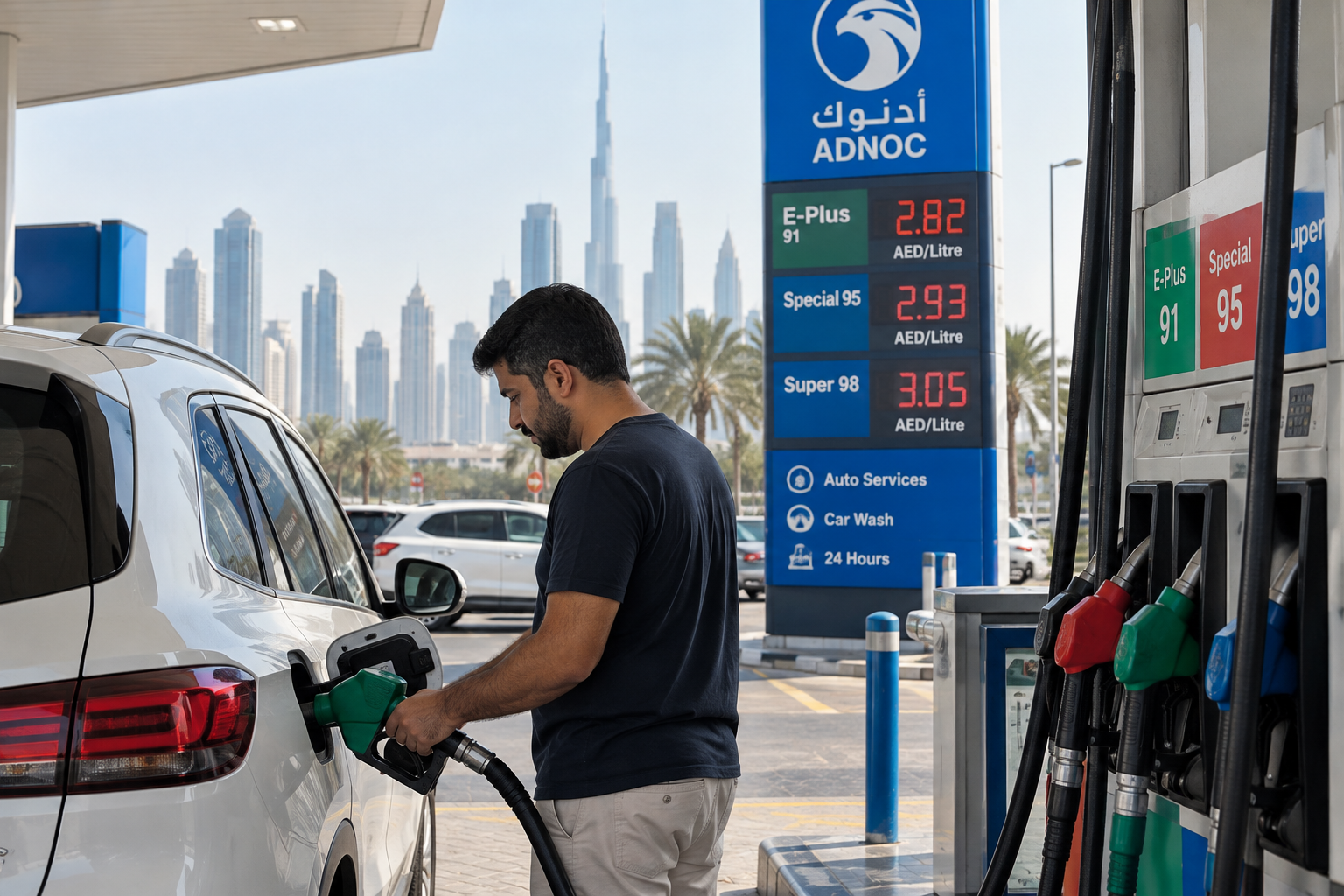
UAE Petrol Prices Jump About 16% for October, Adding Pressure to Household Budgets
uel prices announced for October are around 16 per cent higher for petrol and about 12 per cent higher for diesel. Retail rates have risen more than 60 per cent since the regional war began on 28 February.
UAE Petrol Prices Jump About 16% for October, Adding Pressure to Household Budgets
DUBAI, 3 October 2026 — Drivers across the UAE are paying noticeably more at the pump this month. The fuel prices announced for October took effect on 1 October and lifted petrol by roughly 16 per cent compared with September, according to figures published by Khaleej Times.
The new prices
Here are the per-litre rates now in force, with September's figures for comparison:
| Fuel | October 2026 | September 2026 | Approx. change |
|---|---|---|---|
| Super 98 | Dh4.40 | Dh3.80 | +16% |
| Special 95 | Dh4.28 | Dh3.69 | +16% |
| E-Plus 91 | Dh4.21 | Dh3.61 | +17% |
| Diesel | Dh4.80 | Dh4.30 | +12% |
The percentage changes are our own rounded calculations from the published prices.
What it means at the pump
Because fuel is a regular expense for most households, even modest changes add up. A simple illustration helps. Filling a 50-litre tank with Special 95 cost around Dh184 at September's rate. At October's rate it comes to about Dh214, roughly Dh30 more per fill. A driver who fills up weekly would spend about Dh120 extra over a four-week month on that grade alone. Diesel users face a similar jump of about Dh25 on a 50-litre fill.
Khaleej Times has also reported that some residents are now planning more Dubai Metro journeys and negotiating more days of remote work to limit their driving.
Reading the numbers
In dirham terms, Super 98 rose by Dh0.60 a litre, Special 95 by Dh0.59, E-Plus 91 by Dh0.60 and diesel by Dh0.50. For a commuter who burns around 200 litres of Special 95 in a month, that adds up to roughly Dh118 more than September. Fleet operators and delivery drivers, who cover far greater distances, will notice a much larger difference.
It also helps to look at the longer run. Khaleej Times reports that the rise since the war began is above 60 per cent, which means that even the months when prices slipped, such as July, did not bring them back to anything close to pre-conflict levels.
Why prices have climbed
The UAE adjusts its fuel prices monthly, and the figures follow international benchmarks. Khaleej Times notes that since the Middle East war broke out on 28 February, retail fuel prices in the country have risen by more than 60 per cent overall. The trend has not been a straight line. Prices fell in July after four consecutive monthly increases, then went up again in August and September before this latest jump.
Two developments in recent days are adding to the pressure. The 60-day ceasefire between the United States and Iran has run out, with Washington reportedly not planning an extension, and Tehran has threatened to widen the conflict. Meanwhile the Houthis have intensified attacks on oil infrastructure around the Red Sea. Both factors tend to push crude oil markets higher because they raise the perceived risk to supply.
A familiar monthly ritual, a harder month
Residents have grown used to checking the new rates on the last day of each month, but the pattern this year has been unusually volatile. After four consecutive increases, July brought relief, and then August and September edged up again. October's step is the sharpest of the recent rises, and it arrives while many households are also watching the news from the Gulf for signs of what comes next.
Practical ways to manage the cost
There is no way to avoid the new rates, but drivers have some options:
Choose the right grade. Check your vehicle manual. If the manufacturer recommends 91 or 95, paying more for Super 98 will usually not bring a benefit.
Combine trips. Short, separate journeys use more fuel than a single planned route.
Keep tyres properly inflated. Under-inflated tyres increase fuel consumption.
Consider public transport for regular commutes. The Dubai Metro covers many daily routes, and Etihad Rail now offers an additional option between Abu Dhabi, Dubai and Fujairah.
Ask about flexible working. Some employers are open to hybrid arrangements, particularly when commuting costs rise.
Looking ahead
The November rates are expected to be announced at the end of this month. Whether prices ease or climb again will depend largely on crude oil movements, which in turn depend on the course of the conflict in the region and the security of shipping routes.
For households that are already adjusting to higher costs elsewhere, the October increase is another reminder that events thousands of kilometres away can quickly reach the family budget. Residents who want to keep track can find the monthly rates published at the start of each month.


Leave a comment
Your email address will not be published. Required fields are marked *