
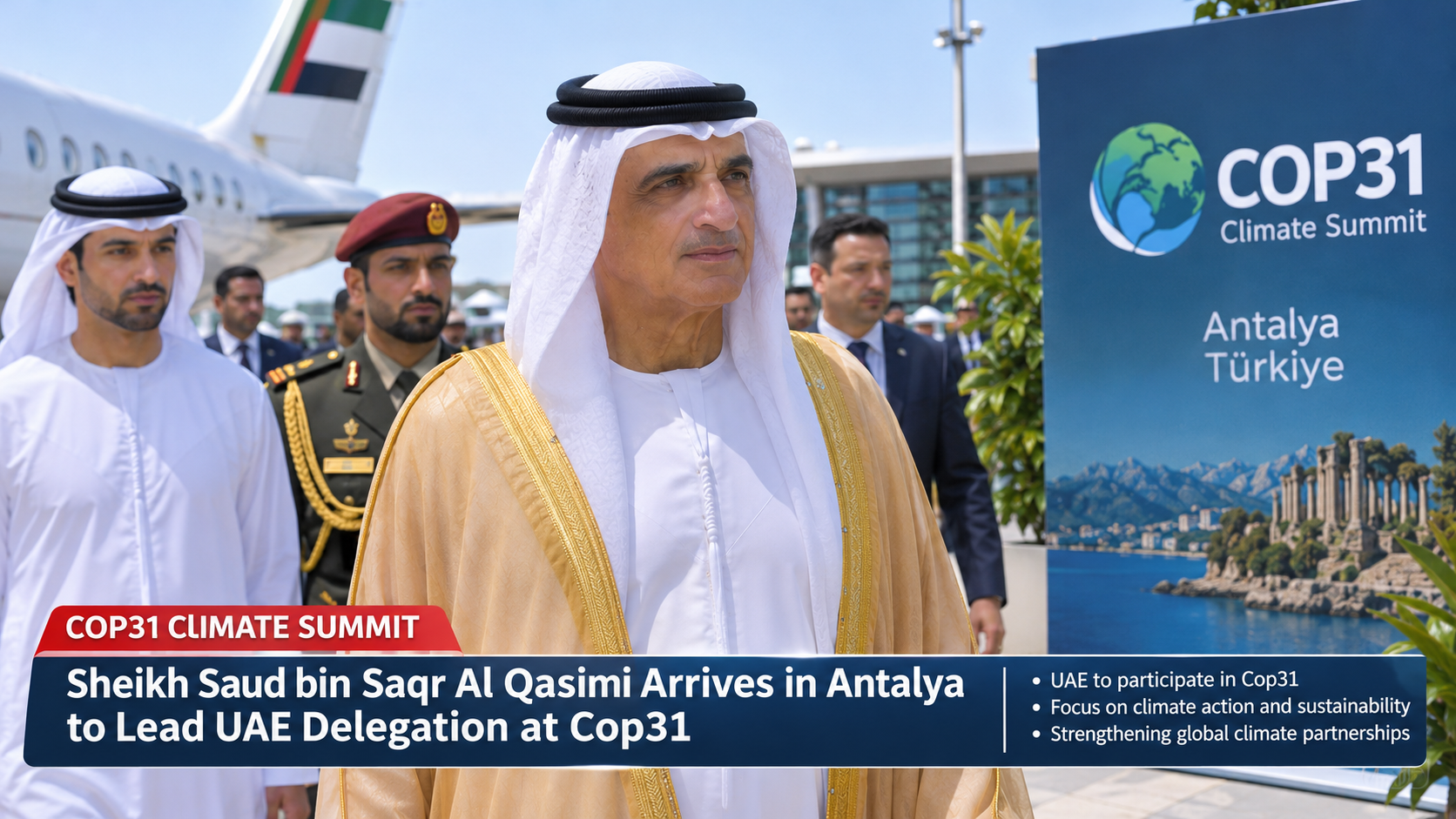
Ruler of Ras Al Khaimah Leads UAE Delegation at Cop31 Climate Summit in Turkey
Sheikh Saud bin Saqr Al Qasimi arrived in Antalya on Wednesday to represent President Sheikh Mohamed at Cop31's two-day Leaders' Summit. The UAE says its focus is turning climate pledges into practical, measurable action.
Sheikh Saud bin Saqr Al Qasimi, Ruler of Ras Al Khaimah and Supreme Council member, arrived in Antalya on Wednesday as head of a high-level UAE delegation to the Cop31 climate summit, where he will represent President Sheikh Mohamed bin Zayed at the Leaders' Summit.
The Leaders' Summit
The two-day Leaders' Summit is being held on 11 and 12 November as part of the wider conference, which Turkey is hosting from 9 to 20 November. Heads of state and government, along with senior officials, are gathering for the high-level segment, which sets the political tone for the negotiations that follow in the second week.
Cop31 opened on Monday with leaders urging the world to move faster on the climate crisis. Speakers pointed to rising temperatures and an increasing number of climate-driven disasters that threaten lives and economies. The World Meteorological Organization has also warned that a very strong El Niño is likely to add heat and extreme weather into 2027, a message that has given the opening days added urgency.
Observers say the host's priorities for the Leaders' Summit include electrification, green industrialisation and finance, reflecting a push to move from broad ambition to the nuts and bolts of delivery.
The UAE's message
The UAE's delegation has described its focus as translating global climate commitments into actionable measures and tangible results. In particular, it points to the outcomes of the UAE Consensus, the agreement reached at Cop28 in Dubai in 2023, as a foundation for that work. The Ministry of Climate Change and Environment is leading the UAE's team in the negotiations.
That framing matters because Cop31 is widely seen as a delivery conference. Earlier summits produced landmark pledges, and the central question now is how those promises are being financed, measured and implemented. For the UAE, which hosted Cop28 and presents itself as a bridge between oil-producing economies and climate ambition, the summit is an opportunity to show how its commitments are being put into practice.
Why it matters at home
Climate policy is not an abstract topic for UAE residents. The country has experienced intense rainfall episodes in recent years, and this very week it is bracing for several days of unsettled weather. Rising heat, water security, energy transition and the resilience of infrastructure are all issues with direct consequences for daily life, business and long-term planning.
The UAE has also positioned itself as an investor in clean energy, both at home and abroad, and as a convener of international climate diplomacy. How its delegation engages in Antalya, from the Leaders' Summit to the technical negotiations, will be watched by partners and critics alike.
What happens next
After the Leaders' Summit concludes on 12 November, negotiators will take over for the remainder of the conference, which runs until 20 November. Key themes expected to dominate include climate finance for developing countries, adaptation and resilience, and how to speed up the shift towards cleaner energy systems.
As is usual at these summits, the final outcome will depend less on the opening speeches than on whether delegations can bridge differences over money, timelines and responsibilities in the closing days. The UAE, as a former host and a major energy producer, is likely to be an active voice in those discussions.
For now, the arrival of Sheikh Saud in Antalya signals the weight the UAE is attaching to the process. Further updates on the delegation's engagements are expected from the Emirates News Agency, WAM, as the Leaders' Summit gets under way.
Leave a comment
Your email address will not be published. Required fields are marked *