
IMF Says Iran War Energy Shock Is "Large but Contained" as Gulf Economies Brace for a Contraction
The IMF's managing director says the energy price shock from the US-Iran war has been large but contained so far, though high prices are likely to linger. The World Bank expects GCC economies to contract by an average of 4.3 per cent this year.
IMF Says Iran War Energy Shock Is "Large but Contained" as Gulf Economies Brace for a Contraction
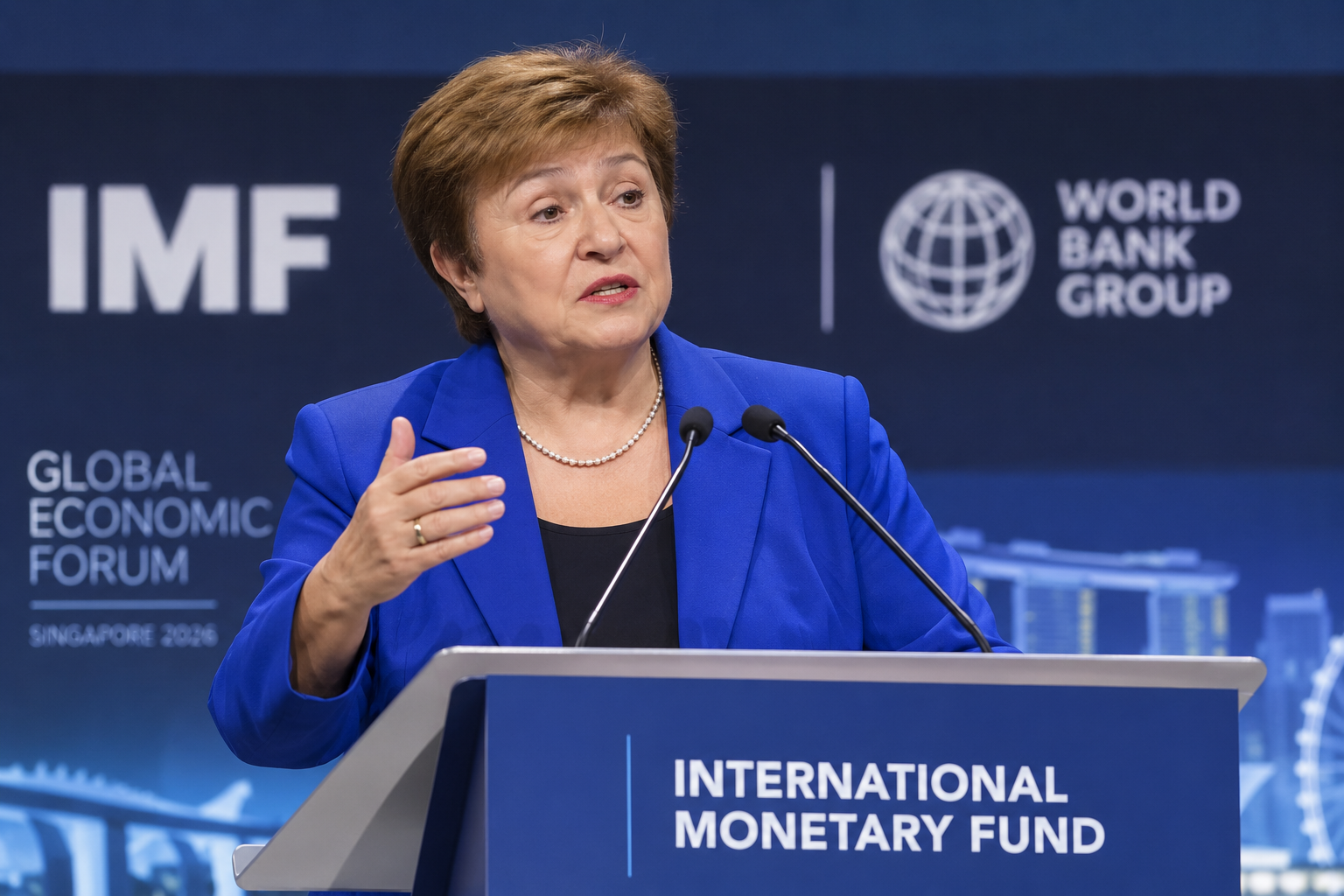
The head of the International Monetary Fund has described the energy price shock from the US-Iran war as large but contained so far, while warning that high prices are likely to stay with the world economy even if the fighting stops soon.
Kristalina Georgieva made the remarks in Singapore, ahead of this year's IMF and World Bank annual meetings in Bangkok. Her message came a day after the World Bank projected a sharp contraction for the GCC economy, underscoring how closely the Gulf's fortunes are tied to the security of its shipping routes.
The numbers behind the slowdown
In a report released on Tuesday, the World Bank said GCC economies will shrink by an average of 4.3 per cent this year. That is 5.7 percentage points lower than its forecast in April. For the wider Middle East, the bank expects the regional economy to contract by 2.1 per cent in 2026.
The IMF also expects the GCC economy to contract this year. But Georgieva said a strong recovery is anticipated next year, on one condition: that shipping returns to normal.
Rerouting oil to keep exports moving
Georgieva credited Gulf governments with limiting the damage by finding other ways to move their energy to market. She made the same point last week in a meeting with GCC finance ministers and central bankers in Bahrain.
The UAE is speeding up construction of the West-East Pipeline, which is due to double export capacity through Fujairah once its expansion is complete in 2027. Saudi Arabia, for its part, has diverted crude through its East-West Pipeline.
Early data suggest the effort is working. According to the ship-tracking firm Kpler, the seven-day moving average for crude exports from the Gulf was 18.3 million barrels a day on 30 September. That compares with an average of about 18 million barrels a day over the 12 months before the war began. The figures include shipments through the Strait of Hormuz and the Red Sea, as well as exports from terminals and ship-to-ship transfers in the Gulf of Oman.
Why prices may stay high
Even so, Georgieva cautioned that the problem of expensive energy would probably outlast the conflict. Disruption to liquefied natural gas supplies is hitting buyers in Europe and Asia especially hard, she said, and pressure could build further as winter approaches and stockpiles run down.
The consequences are already visible in financial markets. The US Federal Reserve and the European Central Bank have started raising interest rates, and the Bank of England is expected to follow next month. The yield on the 10-year US Treasury note, a benchmark for borrowing costs worldwide, reached 5.307 per cent on Monday, its highest level since 2002. Strain has spread to government bond markets in Japan, France, Germany and the UK.
A second force: artificial intelligence
Georgieva also used her speech to argue that the global economy is being pulled in two directions. The war is a drag, while the boom in artificial intelligence is a powerful boost to demand.
Analysts at the Brookings Institution expect AI investment in the United States, spanning data centres, chips and other infrastructure, to total $10.3 trillion between 2025 and 2032. That works out to an average of 3.63 per cent of US output each year. The IMF chief said AI could add up to half a percentage point to global growth annually, a gain comparable to adding an economy the size of ASEAN every year.
She warned, however, that the benefits are uneven and risk widening inequality between countries that capture them and those that do not. She urged governments to put regulation and supervision in place as a first line of defence in case AI earnings fall short of expectations and trigger a market shock.
What it means for the UAE
The Gulf has its own stake in that argument. The UAE aims for artificial intelligence to contribute 20 per cent of its non-oil GDP by 2031, a goal that sits alongside its push to diversify trade routes for energy.
In practical terms, the picture for the UAE is mixed. The country is moving to secure alternative export capacity, and its markets have so far remained steady. But businesses and households remain exposed to higher shipping costs, tighter global financing conditions and fuel prices that have risen for three consecutive months.
What to watch next
Three things will shape the outlook. The first is whether shipping through Hormuz and the Red Sea returns to something like normal, since the IMF's recovery forecast depends on it. The second is how quickly the new pipeline capacity comes online. The third is how central banks respond if energy prices continue to feed into inflation.
For now, the message from the IMF is cautiously reassuring: the shock has been absorbed better than feared, but the costs have not gone away.

Leave a comment
Your email address will not be published. Required fields are marked *