
Dubai Police Chief Calls for Tighter Global Cooperation Against Organised Crime as World Police Summit Opens
The fifth World Police Summit opened in Dubai with a call from the city's police commander for closer cross-border links against organised crime and cyber threats. Speakers also examined how artificial intelligence is reshaping both policing and criminal methods.
The head of Dubai Police used the opening day of the World Police Summit to argue that law enforcement agencies can no longer tackle organised crime alone, as speakers debated how artificial intelligence is changing the contest between police and criminals.
A summit built around cooperation
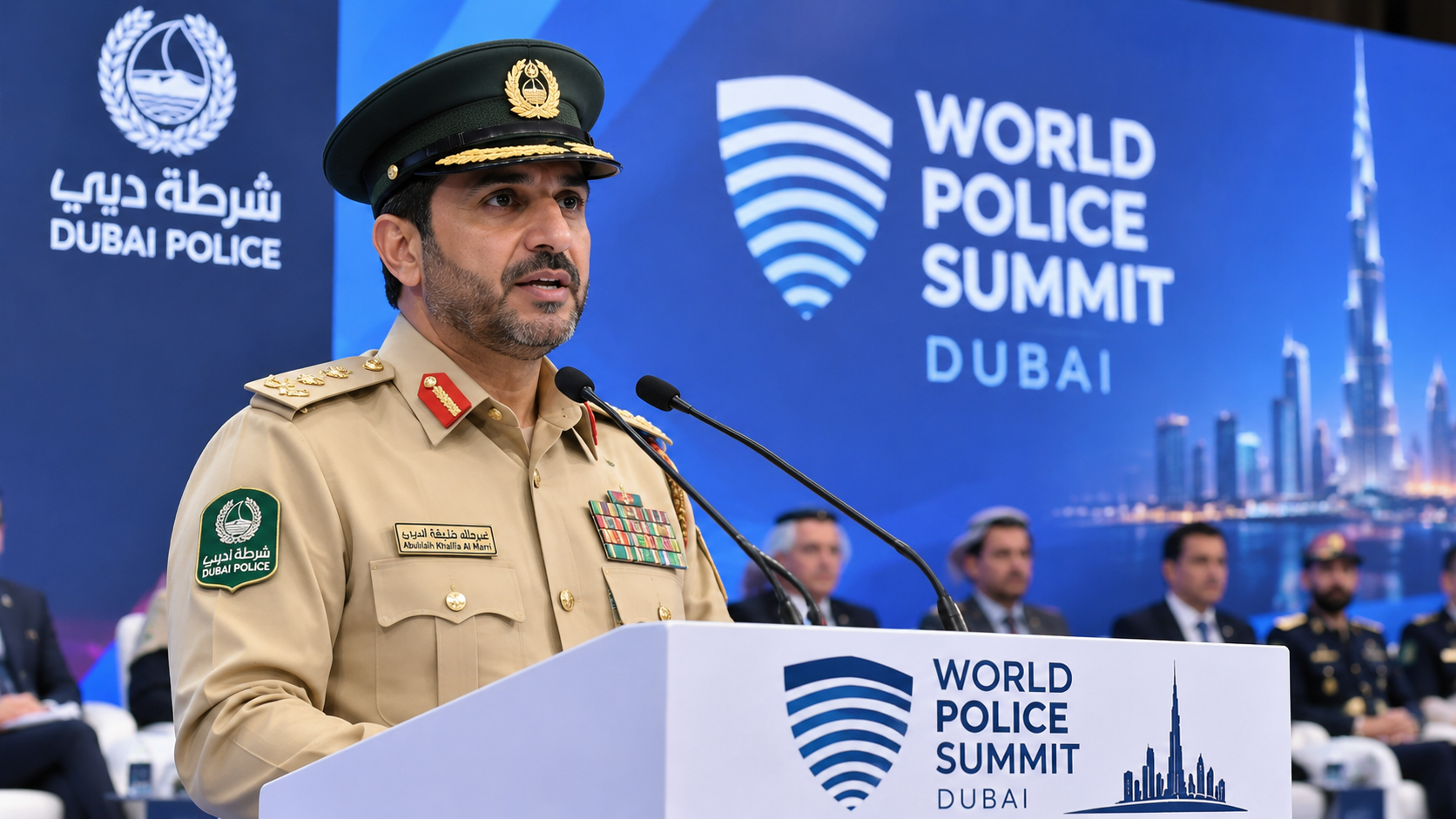
The fifth edition of the World Police Summit opened on Monday at the Dubai World Trade Centre. Maj Gen Abdullah Khalifa Al Marri, Dubai Police commander in chief, delivered a keynote speech in which he warned that extremist groups are exploiting global developments to spread their ideas and destabilise societies, while transnational criminal networks are becoming more sophisticated.
His message was that security underpins development, and that the answer lies in dialogue, the sharing of expertise and best practice, and alliances strong enough to handle fast-changing circumstances. Organised criminals, he said, are adapting their methods to the opportunities that artificial intelligence offers, which means police forces everywhere need to work together more closely.
Dubai's Crown Prince, Sheikh Hamdan bin Mohammed bin Rashid Al Maktoum, who is also Deputy Prime Minister and Minister of Defence, met a number of interior ministers and senior police officials attending the event, the Emirates news agency WAM reported.
The UAE's recent record
The summit comes after several months in which the UAE has been more visible in cross-border criminal cases. In August, the country handed over Daniel Kinahan, an alleged drug kingpin, to Irish authorities after an extradition process. The 49-year-old faces charges that include directing a criminal organisation, murder and drug trafficking.
France has been another close partner. French Justice Minister Gerald Darmanin told The National in September that cooperation with the UAE was an example the wider international community could copy. According to his figures, 28 French citizens have been extradited from the UAE since the start of last year, and 33 apartments belonging to suspected French drug traffickers were seized in the Emirates in 2025.
Mr Darmanin described joint work against drug trafficking and the financial networks that sustain criminal gangs, including money laundering through cryptocurrency and property. Those are precisely the areas where borders matter least to criminals and matter most to prosecutors, which is why cooperation agreements and extradition frameworks sit at the centre of the debate in Dubai this week.
How AI is changing the equation
A second theme on the opening day was technology. Rick Smith, founder and chief executive of the US law-enforcement technology company Axon Enterprise, told delegates that society is living through the fastest technological transformation in human history, and that the pace is still increasing.
He gave concrete examples of what that looks like in the field. Drones can now arrive at an emergency before officers do. Body-worn cameras can stream live audio and video to AI systems, allowing commanders to follow incidents as they unfold and understand what their officers are doing in real time.
Yet Mr Smith also cautioned that criminals are adopting the same tools. That makes it essential, he argued, for governments and security agencies to build digital defences that can adapt as quickly as the threats do.
Protecting digital infrastructure
Mr Smith went further, calling on countries to rethink how they protect critical digital infrastructure. Data centres, he warned, are becoming potential targets during conflicts. He pointed to Ukraine, which has moved some of its critical data to servers in other European countries, and encouraged other nations to consider spreading their digital infrastructure across several geographies to reduce risk.
Security and continuity must be preserved together, he said, so that systems keep running through both physical and cyber attacks. For a region that is living through an active military confrontation, the point carries extra weight. Gulf states host a growing concentration of data centres and cloud capacity as they pursue ambitious technology strategies.
Why it matters for residents
For people living in Dubai, the summit is a window into how the city approaches public safety. Dubai Police has long promoted itself as an early adopter of new technology, and the emphasis at this year's event on AI, drones and digital resilience fits that pattern.
It also reflects a practical reality. Investment fraud, money laundering and cyber crime frequently involve victims and suspects in several countries at once, and cases of that kind are only solved when agencies share information quickly. The calls made on Monday for deeper cooperation are therefore less about diplomacy than about results.
What comes next
The summit continues this week with sessions on cyber threats, emerging technology and international partnerships. Delegates from many countries are attending, and bilateral meetings on the sidelines often produce the practical agreements that later appear as joint operations and extraditions. Observers will be watching whether the cooperation promised on stage turns into new agreements before the event closes.


Leave a comment
Your email address will not be published. Required fields are marked *