ADNOC Becomes First Energy Company to Deploy OpenAI Frontier in Landmark Abu Dhabi Deal
ADNOC has signed a multi-year partnership with OpenAI and G42 at ADIPEC 2026, becoming the first energy company to deploy OpenAI Frontier. The platform will first be used to plan oil fields in hours rather than months and to value barrels while they are still underground.
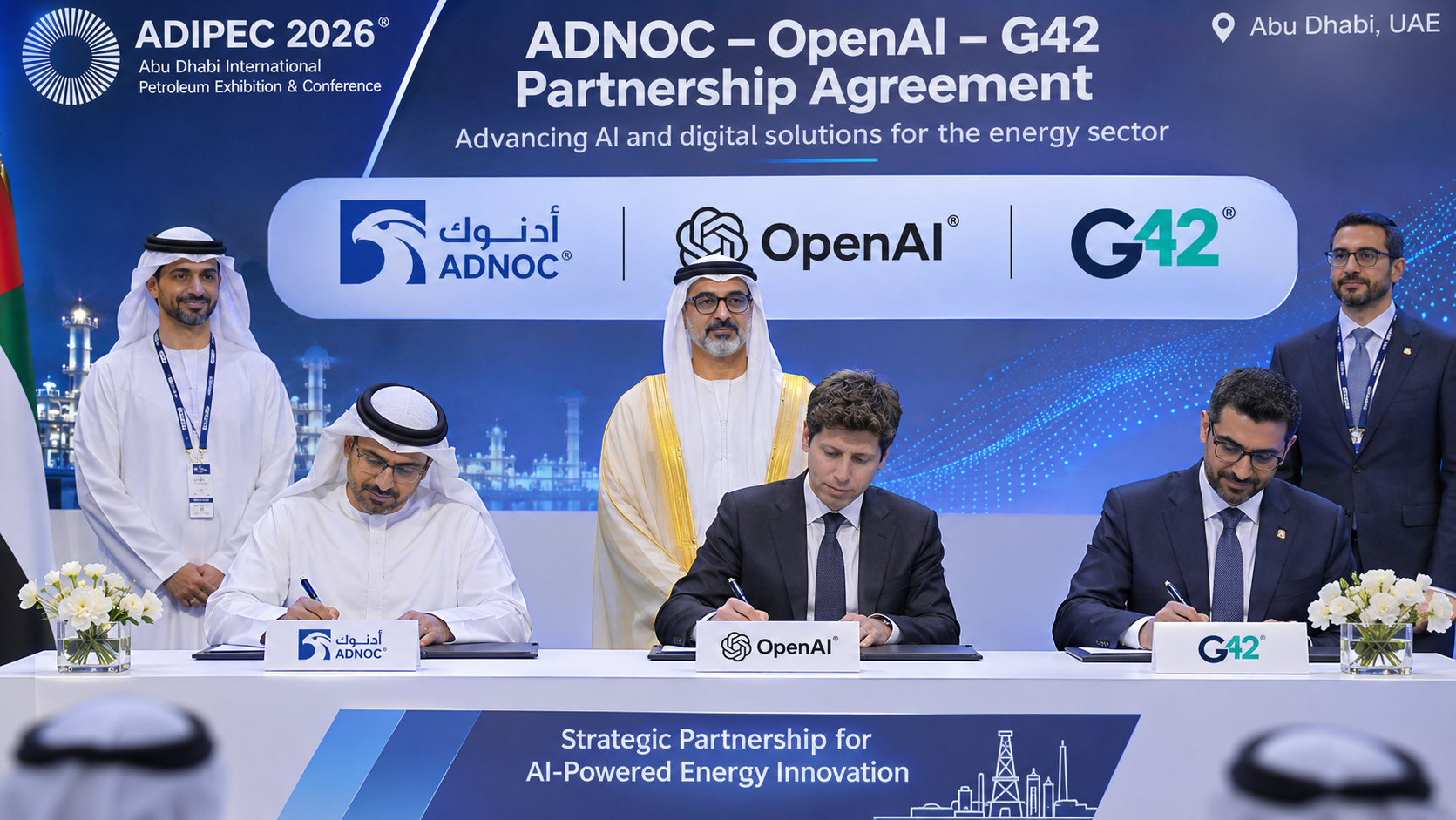
ADNOC has signed a multi-year partnership with OpenAI and Abu Dhabi technology group G42, committing one of the world's largest national oil companies to a far-reaching rollout of artificial intelligence across its operations. The agreement was announced on the opening day of ADIPEC 2026 and makes ADNOC the first energy company anywhere to deploy OpenAI Frontier.
Sheikh Khaled bin Mohamed bin Zayed Al Nahyan, Crown Prince of Abu Dhabi and Chairman of the Abu Dhabi Executive Council, was present at the signing on Monday.
A platform to connect decisions, from well to market
Frontier is designed to coordinate teams of AI agents inside a large organisation. At ADNOC, it will be used to link decisions that have traditionally been taken in separate departments and at different speeds, from the wellhead all the way to the point of sale.
The company already runs a substantial layer of its own AI. ENERGYai, developed with Abu Dhabi's AIQ, builds a detailed picture of ADNOC's reservoirs, assets and operations. Frontier is meant to carry that knowledge across the wider business, so that operational, capital and commercial choices can be weighed together rather than one after another. ADNOC says human experts will keep oversight of the consequential decisions.
First use: planning a field in hours
Two applications will go first. The initial one is field master planning, the process by which operators decide how a field will be developed over its life.
Today that work usually moves in sequence. Subsurface teams complete their studies, facilities engineers respond, and economists then test the result. ADNOC's plan is to fold those steps into a single decision. OpenAI's reasoning models will work through decades of records from thousands of wells, multiple stacked reservoirs and hundreds of surface facilities, while also weighing capital and commercial factors. The company expects to prepare complex development plans in hours instead of months, and to optimise a field as a whole rather than reservoir by reservoir.
Second use: putting a value on oil still underground
The second application is more unusual. ADNOC says it will use networked AI agents to value every barrel while it is still in the ground, and states that no other energy company is applying the technology in this way.
Those agents will continuously forecast crude supply, demand, prices and margins, and weigh what each decision means for production, processing, refining, logistics, sales and trading. In practical terms, a choice about a drilling schedule could be tested against its likely effect on refining margins or shipping commitments before it is made.
What the leaders said
Dr Sultan Ahmed Al Jaber, UAE Minister of Industry and Advanced Technology and ADNOC's Managing Director and Group CEO, said the next stage of AI is not simply about doing things faster. It is about making possible what was previously out of reach.
OpenAI chief executive Sam Altman called the agreement a "first-of-its-kind partnership" that should help ADNOC move faster and decide better across the energy value chain. Mansoor Al Mansoori, CEO of G42 International, tied the deal to national policy, saying the UAE wants to export intelligence responsibly in much the way it has long exported energy.
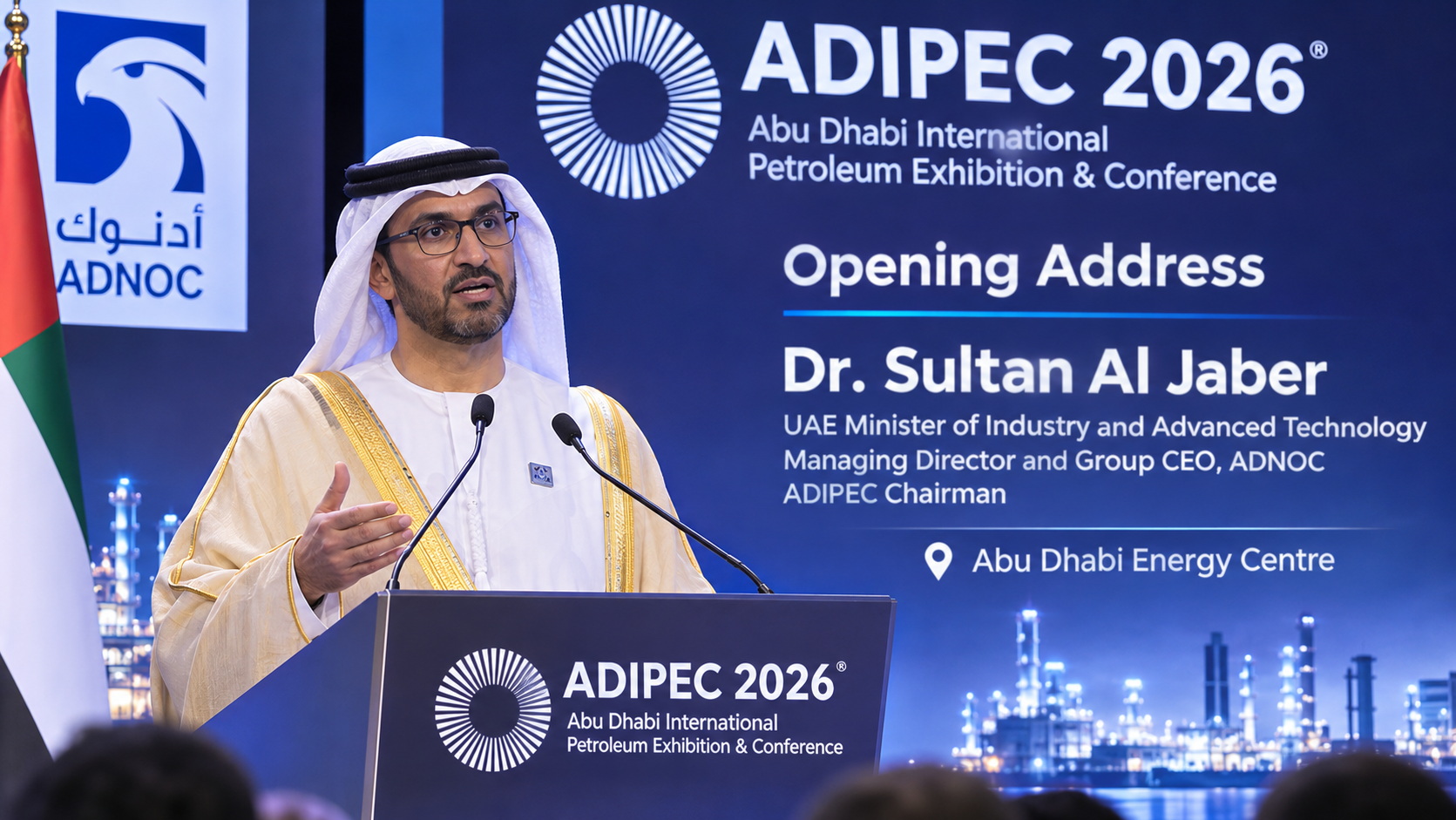
Altman was in Abu Dhabi for the conference, and Al Jaber welcomed him to ADIPEC during his opening address.
Built on a large existing footprint
The agreement does not start from zero. ADNOC has already rolled out ChatGPT Enterprise to more than 40,000 employees, which the company describes as the largest enterprise deployment of ChatGPT in the Middle East and North Africa, with adoption above 97 per cent.
ENERGYai runs on a 70-billion-parameter model trained on more than 50 years of company data. Across the group, ADNOC operates more than 200 AI applications and 70 robotics use cases, either live or under development. Its Real-Time Operations Center links more than 120 rigs in one environment and, according to the company, has cut engineering effort by 30 to 40 per cent.
OpenAI's presence in the UAE has been growing as well. In May 2025, during US President Donald Trump's Gulf visit, OpenAI joined G42, Oracle, Nvidia, SoftBank and Cisco to announce Stargate UAE, a one-gigawatt compute cluster inside the planned five-gigawatt UAE-US AI Campus in Abu Dhabi. It was the first international Stargate deployment.
Why it matters beyond Abu Dhabi
For the oil and gas industry, the significance lies less in any single tool than in the scale and seniority of the commitment. Energy producers have used machine learning for years, mostly in contained corners such as predictive maintenance or seismic interpretation. Giving an agent-based platform a role in field development and commercial valuation, backed by a national oil company's data, is a different order of ambition.
The timing is notable too. In his address, Al Jaber acknowledged that the industry faces growing questions over the electricity and infrastructure that artificial intelligence itself requires. ADNOC's answer, for now, is to say that the technology can make energy operations smarter and more resilient, and that it intends to find out how far that goes.
There are open questions. The announcement did not include financial terms, and the claims about planning speed and valuation accuracy are ADNOC's own expectations rather than results from live fields. Those will take time to show.

Leave a comment
Your email address will not be published. Required fields are marked *