
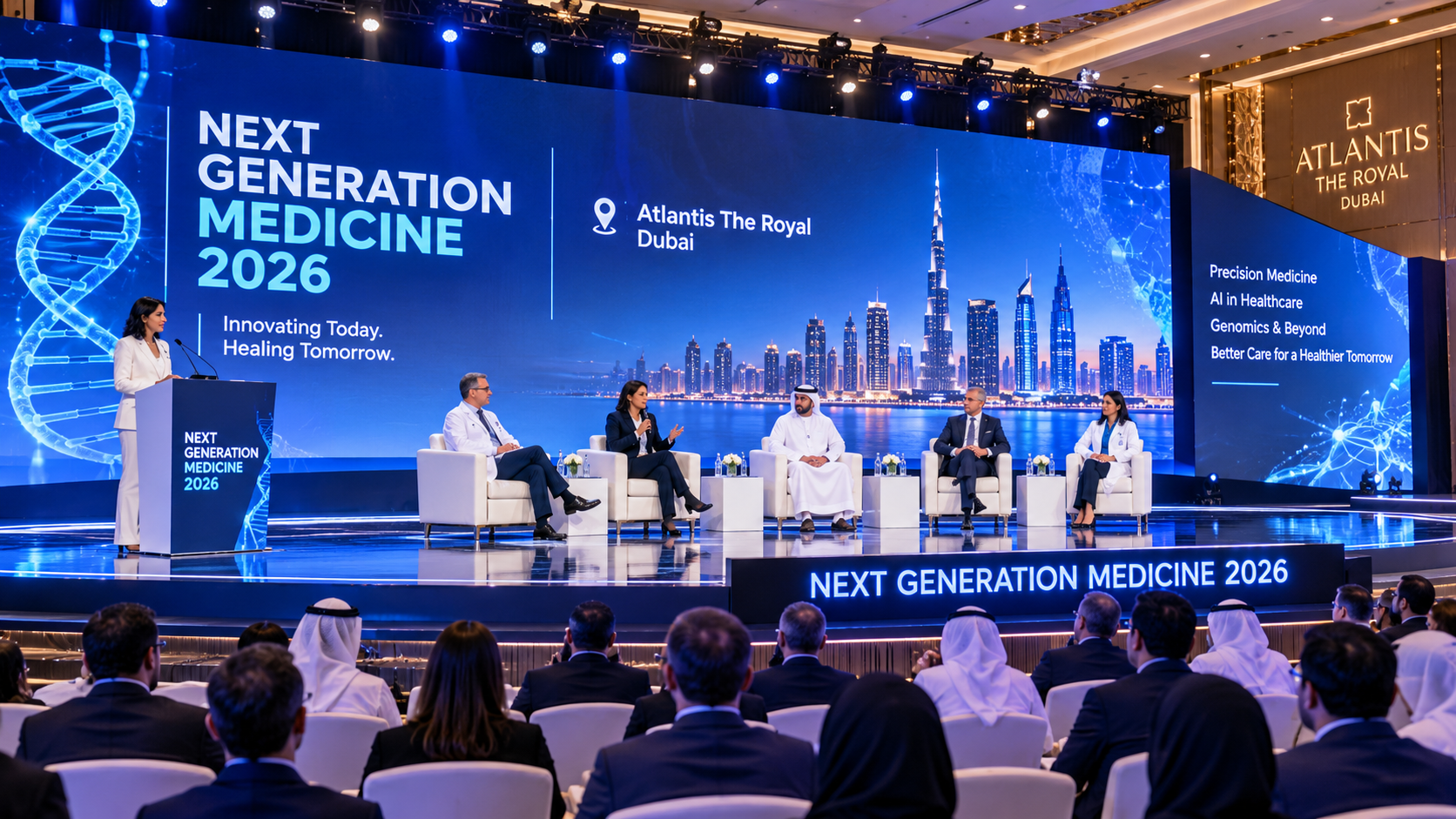
Dubai's Next Generation Medicine 2026 Asks Whether Anti-Ageing Care Can Go Mainstream
More than 70 speakers from over 20 countries opened the Next Generation Medicine 2026 congress in Dubai on Saturday. Discussions centre on whether longevity and preventive treatments can move from premium clinics into routine healthcare by 2030, provided the evidence keeps pace.
Dubai opened its Next Generation Medicine 2026 congress on Saturday, gathering doctors, researchers and healthcare investors to debate a question that once belonged to boutique wellness clinics: can anti-ageing and preventive treatments become part of ordinary healthcare?
The congress, hosted at Atlantis The Royal, brings together more than 70 speakers from over 20 countries. Sessions cover regenerative medicine, artificial intelligence in healthcare, biological-age testing and preventive care. This year's theme, From Evidence to Adoption — Building the Clinic of 2030 Today, signals a focus on moving promising science into safe, regulated practice.
Dubai sharpens its longevity pitch
The event arrives as the emirate works to position itself as a global hub for longevity medicine. That ambition followed the establishment of the Dubai Longevity Authority earlier this year.
It also fits a wider economic picture. Official figures for the first half of 2026 showed healthcare as the fastest-growing sector in Dubai's economy, expanding 14.3 per cent and lifting its share of output to 14 per cent from 12.5 per cent a year earlier. That growth came even as the overall economy contracted in real terms during the regional war.
From wrinkles to wearables
Dr Jaffer Khan, founder and chief executive of AEON Clinic and Aesthetics International, told Arabian Business that the industry is going through a fundamental change. Patients who once walked in with a cosmetic concern now often arrive with blood-test results, wearable-device data and detailed questions about their metabolic, hormonal and gut health. Many want to prevent age-related disease rather than wait for it to appear.
Khan expects prevention-led assessment to become a routine part of mainstream care within this decade instead of a premium add-on. Several of the tools behind that shift are already in clinical use, among them genomic screening, advanced imaging, biomarker testing and continuous health monitoring.
Evidence still has to catch up
Availability, though, is not proof. Khan was careful to separate established tools from unproven ones. Some regenerative and cellular therapies remain under investigation and need stronger clinical evidence before wider adoption. In his view, certain areas are closer to the mainstream than many people assume, while others are further off than some providers suggest, and it is important to be precise about which is which.
That caution runs through the congress's framing. Longevity medicine has attracted heavy commercial interest, and the gap between marketing claims and demonstrated benefit is where clinicians and regulators are most alert.
From wellness trend to investment category
Beyond the consulting room, longevity is turning into a business proposition. Khan described the field as maturing from a consumer wellness trend into a serious investment category, supported by growing demand for preventive care, favourable government policy and rising capital.
He pointed to five areas with room to grow: diagnostic platforms, physician-led longevity clinics, regulated regenerative medicine, AI-enabled healthcare technology and medical education.
He also offered a test for operators. A wellness business, he said, can be measured by footfall and repeat visits, whereas a longevity clinic should be judged on governance and measurable outcomes.
Can Dubai compete?
Established centres in Switzerland, elsewhere in Europe and the United States have deep scientific traditions. Khan argued that Dubai offers a different mix of science, capital and speed of execution. Its international air connections, hospitality infrastructure and regulatory ambitions, he said, give it an advantage in attracting overseas patients who want preventive treatment.
Still, he stressed that credibility will depend less on bold anti-ageing promises and more on showing that treatments deliver real health benefits. Public trust, in his words, will come from good medicine, open communication and a willingness to measure results, not from talk of immortality.
What it means for residents
For people living in the UAE, the practical takeaway is that preventive screening and data-driven check-ups are likely to become more common. If Khan's forecast proves right, they could also become more accessible by the end of the decade.
Anyone considering newer treatments would be wise to look for regulated providers and to ask what clinical evidence supports a particular therapy before committing time or money.
As the congress gets under way, the discussions reflect a broader shift in healthcare: away from treating illness after it appears and towards spotting risk early and helping people stay well for longer.


Leave a comment
Your email address will not be published. Required fields are marked *